Category: Site Preparation

  • Private Road Clearing Guide for Colorado Landowners

    Private Road Clearing Guide for Colorado Landowners

    A private road can look passable right up until it is not. Brush crowds the mirrors, low branches scrape equipment, runoff cuts ruts into the travel lane, and one downed tree blocks an emergency vehicle. This private road clearing guide gives Colorado landowners a practical way to assess the problem, clear the right ground, and build access that holds up when conditions get rough.

    Start With the Road’s Real Job

    Do not clear a road based on appearance alone. Start by defining who needs to use it and under what conditions. A driveway serving one residence has different needs than an access road supporting a ranch, a construction project, multiple homes, or wildfire response.

    Walk or drive the full route before any equipment mobilizes. Look beyond the obvious brush. Mark tight turns, soft shoulders, steep sections, blind corners, drainage crossings, gates, culverts, overhead lines, and areas where the road narrows. Note where a pickup can pass today, but a fire engine, delivery truck, trailer, or excavation crew cannot.

    The goal is not to strip every inch of vegetation from the property. The goal is clear, dependable access. That usually means opening the travel corridor, improving sightlines, removing hazardous trees and brush, and correcting the drainage problems that keep damaging the road.

    Check Ownership, Easements, and Boundaries First

    Private roads often cross more than one parcel. Before clearing begins, confirm who owns the road and who has access rights. An easement may set the route, the allowed width, maintenance responsibilities, or limits on work outside the established corridor.

    This matters most when trees, fences, drainage features, or utility lines sit near the road edge. A contractor can clear heavy growth quickly with the right machine, but speed does not replace permission. Get agreement from affected owners before removing vegetation or changing the road footprint.

    If the road serves a homeowners association, shared ranch access, or a development parcel, establish who approves the scope and who will maintain the finished work. A newly cleared road still needs upkeep after spring runoff, wind events, and winter damage.

    Set a Clear Travel Corridor

    Road clearing starts at the edge of the tires, then expands outward only as far as the road’s use demands. Light vegetation brushing the lane may be a nuisance. Dense brush and low limbs can reduce visibility, trap moisture, add wildfire fuel, and force vehicles toward unstable shoulders.

    For most properties, the clearing plan should address three areas: the driving surface, the immediate roadside, and the overhead path. The driving surface needs firm, unobstructed passage. The roadside needs enough room for visibility, drainage, and safe vehicle recovery. The overhead path must accommodate the tallest vehicle expected to use the route.

    There is no single width that fits every road. A narrow mountain driveway may need targeted trimming and a few widened passing points. A road that must handle construction deliveries or emergency equipment needs more room, stronger shoulders, and broader turns. Clearing too little leaves the same access problem in place. Clearing too much can create unnecessary cost, expose soils, and remove useful screening vegetation.

    Remove the Growth That Creates Real Risk

    Prioritize vegetation that blocks movement or creates a hazard. That includes dead or leaning trees, low limbs, thick brush at blind corners, volunteer trees encroaching into the road, invasive growth, and woody fuel buildup along the route.

    Forestry mulching is often a strong fit for dense brush, small trees, and overgrown roadside vegetation. A high-flow compact track loader with a drum mulcher can work through uneven Colorado ground while processing material into mulch close to where it stands. That can reduce hauling, eliminate burn piles, and leave a cleaner finish than pushing slash into heaps.

    Larger timber, utility conflicts, protected areas, and extremely steep slopes may require a different approach. A good scope matches the machine and method to the terrain instead of forcing one solution onto every mile of road.

    Handle Drainage Before It Handles Your Road

    Vegetation clearing improves access, but water determines whether that access lasts. A road that holds water or sends runoff down the wheel tracks will rut, washboard, soften, and fail. Clearing without drainage work can make the surface look better for a short time while the real problem remains underneath.

    Watch how water moves during rain or snowmelt. Standing water, muddy depressions, exposed aggregate, eroded ditches, and deep ruts all point to drainage trouble. Check culvert inlets and outlets for brush, sediment, rock, and debris. A blocked culvert can redirect runoff across the road and cut it apart fast.

    The road surface should shed water instead of trapping it. Depending on the grade and terrain, that may mean restoring a crown, cleaning or reshaping ditches, opening outlet paths, adding water bars, or installing and sizing culverts correctly. On steep mountain ground, small drainage details make a major difference.

    Avoid pushing brush, mulch, or soil into ditches and drainage crossings. It may look like cleanup, but it can block flow and create a bigger repair later. Keep outlets open and protect the ground below them from erosion where needed.

    Repair the Base, Not Just the Ruts

    Ruts are a symptom. The cause may be weak subgrade, poor drainage, insufficient aggregate, overloaded traffic, or a road grade that sends water straight downhill. Filling holes without fixing the cause usually buys a short window before the damage returns.

    After clearing, inspect the road base. Soft sections may need excavation and rebuilding. Low spots may need material and compaction. Heavily traveled roads may need new aggregate, grading, and a compacted driving surface. If water is moving across the road, correct that flow before placing fresh material.

    Grade work should be deliberate. Over-grading can remove good material, flatten the crown, and push gravel into the ditch. The right finish is smooth enough for reliable travel but shaped to drain. It also needs enough strength for the vehicles that will use it, not just the vehicle inspecting it on a dry day.

    Build Wildfire Readiness Into the Clearing Plan

    A private road is part of a property’s defensible-space strategy. It is also an evacuation route and a potential access route for firefighters. Heavy roadside fuels can increase fire intensity near the road, block visibility, and make the route harder to use when seconds matter.

    Focus on reducing continuous fuels along the access corridor. Remove dead brush, ladder fuels, and dense small trees where they create a connected path for fire. Prune or remove vegetation that narrows the route. Keep turnaround areas, gates, and address markers usable.

    Do not confuse wildfire mitigation with bare ground. Healthy spacing, selective removal, and mulched material can be more effective and more stable than indiscriminate clearing. Site conditions matter. A dry, dense foothills parcel calls for a different treatment than a wet mountain road or an open Western Slope acreage.

    Choose the Right Time and Contractor

    Road clearing can happen in many seasons, but timing affects the work. Dry conditions may allow cleaner access and better grading. Frozen ground can support equipment in some areas. Wet soil, active runoff, nesting concerns, and seasonal fire restrictions may change the plan.

    Ask a contractor how they will access the road, manage debris, protect drainage, and handle steep or soft ground. Ask what equipment fits the job and whether they can combine clearing, forestry mulching, grading, and site preparation in one coordinated scope. One crew that can clear the corridor and address the road condition can prevent the handoff problems that leave work unfinished.

    For Colorado properties with rugged access, Yeti Defensible Landworks brings equipment-forward clearing and grading work to the ground that needs it most. The right plan protects the route without treating every property like a flat, open lot.

    Keep the Road Clear After the Heavy Work

    A cleared private road needs routine attention, especially after storms and runoff. Walk it after major rain, spring snowmelt, or high winds. Remove new debris before it becomes a blockage. Keep culvert inlets open, cut back fast-growing roadside vegetation, and repair small ruts before traffic turns them into deep failures.

    Set a maintenance standard based on use. A seasonal cabin road may need inspection before and after winter. A shared residential road or working ranch route may need scheduled checks throughout the year. The cost of regular trimming and drainage cleanup is usually far lower than an emergency repair when access is blocked.

    A dependable road does more than get you from the gate to the house. It gives your property a safer way in, a safer way out, and a stronger foundation for every project that comes next.
  • Comprehensive Land Clearing That Gets Land Ready

    Comprehensive Land Clearing That Gets Land Ready

    A property can look green and still be working against you. Dense Gambel oak, scrub brush, volunteer trees, deadfall, and invasive growth can block access, feed a fast-moving fire, and make useful acreage impossible to use. Comprehensive land clearing puts the ground back in your control – with a defined plan for what stays, what goes, and what the land needs next.

    This is not a quick pass with a mower or a pile of cut brush left behind. Done right, clearing improves safety, creates workable space, and leaves the site ready for the job ahead. That could mean defensible space around a mountain home, a clean building envelope, a drivable access route, usable pasture, or a commercial site that is ready for grading.

    What Comprehensive Land Clearing Actually Includes

    Every property starts with a different problem. Some need heavy brush and small trees removed from several acres. Others need a narrow but reliable route opened through overgrowth. A good clearing plan matches the work to the property’s end use instead of treating every acre the same.

    Comprehensive work may include brush removal, small-tree thinning, invasive vegetation removal, deadfall cleanup, forestry mulching, site preparation, rough grading, and cleanup of accumulated wildfire fuels. It can also include clearing around fences, outbuildings, roads, utility corridors, and future construction areas.

    The point is not to strip land bare. The point is to remove the material that creates risk or prevents use while preserving the trees, contours, drainage paths, and healthy vegetation worth keeping. On Colorado properties, that judgment matters. Overclearing can expose soil, invite erosion, and leave a site looking rough. Underclearing leaves the fuel load and access problem in place.

    Start With the End Use, Not the Equipment

    Heavy equipment gets the work done, but the plan determines whether the result holds up. Before clearing begins, identify what the property needs to do when the work is finished.

    A homeowner focused on wildfire mitigation may need spacing between trees, reduced ladder fuels, and a cleaner zone around structures. A landowner planning a barn or home needs a stable, accessible building area and room for construction traffic. A ranch or acreage owner may need brush removed from fence lines, gates, and pasture edges. A developer may need vegetation cleared, access improved, and the site prepared for the next phase of earthwork.

    Those goals change the approach. A building pad may require clearing followed by grading. A fuel-reduction project may call for selective thinning and mulching rather than full removal. A steep parcel may need a lighter touch to protect slopes and drainage. Clear the wrong areas first, and you can create extra expense later.

    Mark What Must Stay

    Property owners should walk the site before work begins. Mark trees to retain, wells, septic components, irrigation lines, monuments, fences, utilities, and areas with limited access. If you have a survey, site plan, or proposed driveway alignment, have it ready.

    Visible marks and a clear scope prevent costly guesswork. They also help the operator work faster and protect the features that matter to you. Underground utilities deserve special attention. Never assume a line is inactive or accurately shown by old surface clues.

    Forestry Mulching vs. Traditional Clearing

    Forestry mulching is often the right tool for dense brush, saplings, small trees, and accumulated fuels. A high-flow compact track loader with a drum mulcher can cut and process vegetation close to the ground, leaving mulch spread across the site instead of creating large burn piles or haul-off loads.

    That mulch can help moderate soil temperature, reduce surface erosion, and slow the return of some growth. It also removes the standing and ladder fuels that allow fire to move from grass and brush into tree canopies. On rough Colorado terrain, track equipment can reach areas that are difficult for larger machines without opening unnecessary disturbance.

    But mulching is not the answer to every clearing job. Large trees may need separate removal. Thick material, construction debris, rock, old wire, and hidden metal can change the plan. If a site must be graded for a foundation, road, or drainage improvement, vegetation removal is only the first phase. Mulch may also need to be managed differently in high-traffic areas or where future excavation is planned.

    Traditional clearing methods may make sense when material must be removed from the site, when major excavation is coming, or when mature timber requires a different approach. The right method depends on the vegetation, slope, soil, access, fire-risk goals, and final use of the land.

    Fire Mitigation Is More Than Cutting Brush

    Colorado’s wildfire exposure is not limited to homes deep in the foothills. Properties near open space, grassland, draws, wooded lots, and unmanaged acreage can all carry heavy fuels. Wind, slope, and dry vegetation can turn a neglected edge of the property into a serious vulnerability.

    A defensible-space project focuses on how fire can approach and move through the site. That means reducing dense brush near structures, removing dead and down material, limbing or thinning where appropriate, and creating workable access for residents and emergency equipment. It also means keeping vegetation managed after the initial project.

    No contractor can make a property fireproof. Weather, neighboring fuels, construction materials, and emergency conditions all matter. What land clearing can do is reduce available fuel, break up continuous vegetation, improve visibility and access, and give your property a better starting position.

    Access, Drainage, and Grade Need to Work Together

    A cleared route is not automatically a usable route. Driveways, emergency access paths, gate approaches, and equipment lanes need enough width, stable ground, and sensible drainage to remain functional when weather turns.

    This is where clearing and site preparation should work together. Removing brush may reveal ruts, soft ground, washouts, rock, or sharp changes in grade. Addressing those issues during the same project can prevent a cleared access route from becoming impassable after the next hard rain or spring runoff.

    On sloped ground, water always gets a vote. Clearing should avoid sending runoff directly toward a home, road, or neighboring parcel. Retaining ground cover where possible, shaping drainage intentionally, and avoiding unnecessary soil disturbance help protect the work after the machines leave.

    What Drives the Cost of Land Clearing

    A price based only on acreage tells you very little. One acre of grassland is not one acre of tangled oak, standing dead trees, boulders, steep grades, and limited access. The condition of the site drives production.

    The biggest cost factors are vegetation density and size, terrain, distance from a workable staging area, obstacles, desired finish, and whether material can be mulched onsite. Projects also change when there is trash, fencing, wire, old equipment, or buried debris hidden in the brush. These hazards slow the work and can damage equipment.

    A clear scope gives you a better estimate and a better result. Define the work area, identify the vegetation to remove, explain the intended use, and state whether you need mulching, haul-off, grading, access work, or restoration. Photos are useful, but an onsite look is often the fastest way to spot the conditions that affect the job.

    Prepare Your Property Before the Crew Arrives

    A few practical steps keep the project moving. Move vehicles, trailers, and loose materials out of the work zone. Unlock gates or arrange access. Keep pets and people clear of active equipment. Mark irrigation heads, septic lids, utility boxes, and anything that could be damaged or buried under vegetation.

    If the work is near a home or business, plan for noise, dust, and temporary limits on access. Clearing is active, physical work. Good communication before mobilization keeps the site safer and reduces downtime.

    Yeti Defensible Landworks brings equipment-forward, veteran-owned accountability to difficult Colorado ground. Whether the job is wildfire-fuel reduction, access improvement, site prep, or an overgrown acreage cleanup, the target stays simple: clear it with purpose and leave the property ready for what comes next.

    The best time to address dense fuels and blocked access is before they become an emergency, a failed project schedule, or a costly obstacle. Walk your land with the finished condition in mind, then build the clearing plan around that result.

  • Denver Commercial Lot Cleanup That Clears the Way

    Denver Commercial Lot Cleanup That Clears the Way

    A neglected lot sends a message before a customer, tenant, inspector, or contractor ever reaches the front door. Overgrown brush, dumped debris, blocked fence lines, and rough access can turn usable commercial ground into a safety problem. Denver commercial lot cleanup puts the property back under control – clearing hazards, opening access, reducing fuel loads, and preparing the site for the next job.

    For commercial owners and managers, cleanup is rarely about appearance alone. It is about keeping operations moving, protecting people on site, preserving access for crews and vehicles, and making the property ready for lease, construction, storage, or sale.

    When a Commercial Lot Needs More Than Mowing

    A mower can handle maintained grass. It cannot solve a lot choked with woody brush, volunteer trees, invasive vegetation, construction remnants, and accumulated debris. Those conditions need the right equipment and a clear work plan.

    Commercial lots commonly fall behind after a tenant leaves, a project stalls, ownership changes, or a parcel sits vacant through several growing seasons. Along the Front Range, dry grass, brush, and low-hanging limbs can also build wildfire fuel loads fast. What started as a minor maintenance issue can become an access, fire, and liability concern.

    A proper cleanup starts by identifying what is actually on the ground. Dense vegetation, small trees, trash, concrete, scrap material, uneven terrain, drainage features, and utility access all affect how the work should be handled. The goal is not to run equipment across the site and hope for the best. The goal is to leave clean, usable ground without creating new problems.

    What Denver Commercial Lot Cleanup Can Accomplish

    The right scope depends on the property, but the result should be clear: safer ground that is easier to manage and ready for its intended use. Cleanup may include vegetation removal, forestry mulching, debris gathering, access clearing, light site preparation, and grading where appropriate.

    Forestry mulching is often a strong fit for overgrown commercial parcels. A high-flow compact track loader with a drum mulcher can process brush, small trees, and woody growth into mulch close to the ground. That eliminates burn piles, reduces hauling in many cases, and leaves a protective mulch layer that helps limit erosion and slows regrowth.

    Mulching is not the answer for every material. Trash, tires, metal, treated lumber, concrete, and other dumped waste need to be separated and removed through the proper disposal path. If a lot contains suspected hazardous material, unknown containers, or sharp debris buried in vegetation, the work plan needs to slow down. Safety comes first. Clearing fast is worthless if the site is left with hidden hazards or damaged utilities.

    For properties headed toward development, cleanup can also give surveyors, engineers, utility crews, and construction teams the access they need. Clearing fence lines, creating equipment paths, opening a staging area, or removing vegetation from a future building pad can prevent delays later.

    Clean Access Changes the Whole Job

    A commercial lot is only useful if people and equipment can reach the parts that matter. Gates that will not open, service lanes swallowed by brush, and soft or rutted approaches can stop work before it starts.

    Access improvements may be as simple as clearing limbs and brush from an existing drive. On tougher sites, they may involve cutting back encroaching vegetation, widening a route for equipment, improving visibility at an entrance, or grading rough ground so trucks can move safely.

    This is where equipment matters. Compact track loaders bring low ground pressure and strong traction to uneven Colorado terrain. Paired with the right attachment, they can work where larger machines may be impractical or where wheeled equipment would tear up the surface. There is still a trade-off: tight lots, steep slopes, wet ground, and buried debris can limit production. A disciplined contractor plans around those conditions instead of promising a one-size-fits-all solution.

    Fire Risk Does Not Stop at the Property Line

    Commercial owners in and around Denver often think wildfire mitigation applies only to mountain homes. The risk is broader than that. Vacant parcels, storage yards, business campuses near open space, and undeveloped edge lots can all collect fine fuels, brush, dead growth, and ladder fuels.

    Reducing those fuels does not make a property fireproof. It does create better separation, reduce available vegetation for fire, improve access for response, and make ongoing maintenance more manageable. On properties bordering grassland, greenbelts, ravines, or wooded areas, that work can be a practical part of protecting structures and operations.

    The best results come from looking beyond the obvious patch of tall grass. Brush beneath small trees, dead material trapped along fences, vegetation around utility equipment, and unmanaged edges all deserve attention. A clean lot should be functional, not just freshly cut from the street.

    Plan Cleanup Around the Property’s Next Use

    Before equipment arrives, decide what the lot needs to become. That answer determines the scope.

    A property being marketed for lease may need visible cleanup, open access, and trimmed edges that show its usable footprint. A construction-bound site may need brush removed from work areas, staging space opened, and rough terrain addressed. A storage yard may need clear vehicle routes, reduced fire fuel, and manageable perimeter vegetation. A parcel being held long term may benefit most from mulching and a maintenance plan that prevents another major reset in two years.

    Do not pay for work that does not support the next phase. Clearing every tree on a lot headed for a low-impact use may be unnecessary. On the other hand, leaving dense brush around future access routes can force a second mobilization when construction begins. Good site preparation matches the budget to the real objective.

    Questions to Answer Before Booking Work

    A site walk goes faster when the owner or manager can identify the property’s priorities. Be ready to discuss where crews can enter, what areas need to remain untouched, whether utilities or irrigation are present, and what materials are known to be on site.

    It also helps to clarify whether debris must be hauled away, whether vegetation can be mulched on site, and whether the work needs to meet a deadline for inspection, leasing, or construction. Photos are useful, but difficult terrain, hidden dumping, and access constraints often require an on-site look before the scope is finalized.

    Choose Execution, Not Just a Low Number

    Commercial lot cleanup is not a commodity when the ground is rough and the stakes are real. A low bid can become expensive if the crew lacks the right equipment, ignores site conditions, damages a fence or utility feature, or leaves piles that still need to be dealt with.

    Look for a contractor that can explain the equipment being used, the disposal plan, the limits of the work, and what the site will look like when the job is complete. Clear communication matters. So does showing up prepared to work safely around active businesses, neighboring properties, public roads, and changing Colorado weather.

    Yeti Defensible Landworks brings a veteran-owned, safety-first approach to difficult land. With modern compact track loader and drum mulching capability, the crew can clear brush, reduce wildfire fuels, improve access, and prepare commercial ground for practical use across the Denver Metro and surrounding Colorado counties.

    A commercial lot does not need to stay a liability because it has been neglected, overgrown, or used as a dumping ground. Start with a clear plan, put capable equipment on the ground, and turn the property into something crews, tenants, and customers can actually use.

  • How to Improve Private Road Access in Colorado

    How to Improve Private Road Access in Colorado

    A private road can look passable right up until a delivery truck slides into a rut, an ambulance cannot turn around, or spring runoff cuts a channel through the driving surface. To improve private road access, start by treating the road as a working piece of infrastructure, not just a trail through the property. Clear the corridor, control water, shape the grade, and build a surface that fits the traffic it must carry.

    For Colorado acreage, mountain homes, ranches, and undeveloped parcels, access work often solves more than a driving problem. It can improve emergency response, support wildfire mitigation, create room for construction equipment, and make daily property use safer.

    Start With the Real Access Problem

    Not every rough road needs a full rebuild. The right scope depends on what is failing and how the road will be used. A seasonal road serving a cabin has different needs than a driveway used daily by heavy pickups, horse trailers, propane trucks, or construction equipment.

    Walk or drive the route after rain or snowmelt if possible. Water exposes weak points fast. Watch for standing water, soft shoulders, tire ruts, washboarding, exposed rock, low branches, blind corners, and places where two vehicles cannot safely pass. Also look at the road’s entry point. A narrow gate, sharp turn, or steep approach can limit access even when the rest of the road is in decent shape.

    Ask a practical question: what must get down this road when conditions are bad? If the answer includes fire apparatus, emergency vehicles, utility crews, concrete trucks, or material deliveries, the road needs more than a smooth-looking surface.

    Clear the Road Corridor First

    Overgrown brush and low limbs slowly close in on private roads. They scratch vehicles, block sightlines, hide hazards, trap snow, and interfere with larger equipment. In fire-prone areas, roadside vegetation can also add fuel directly beside the route people may need to use for evacuation or emergency access.

    Clearing should create usable width, not simply cut back a few branches. Remove encroaching brush, small trees, deadfall, and invasive growth that restrict the travel lane, shoulders, turnarounds, gates, and drainage paths. Keep enough open space for drivers to see around curves and for equipment to work without tearing up the road edge.

    Forestry mulching is often a strong fit where dense brush or small-diameter trees are the main problem. A high-flow compact track loader with a drum mulcher can process vegetation on site, reduce hauling, and leave the ground more manageable than a pile of slash. The best approach depends on slope, soil condition, property goals, and whether the cleared material should remain as mulch or be removed from key areas.

    Do not clear so aggressively that bare soil is left exposed on steep shoulders. The goal is controlled access, not creating the next erosion problem.

    Drainage Does the Heavy Lifting

    Most private roads fail because water has nowhere useful to go. A road can have fresh gravel and still break down quickly if runoff flows across it, drains into the wheel tracks, or spills over a low edge.

    The driving surface needs a defined crown or cross-slope so water sheds off the road instead of pooling in the center. Ditches, swales, culverts, and rolling dips may be needed to collect and move water safely. Which option works depends on the grade, soil, watershed, existing crossings, and where runoff can discharge without damaging neighboring land or downstream areas.

    Culverts deserve particular attention. A clogged, undersized, crushed, or poorly placed culvert can turn a minor drainage crossing into a washed-out road. Before replacing one, verify the pipe location, the flow path, and the condition of the inlet and outlet. A pipe that moves water under the road but dumps it onto an unstable slope is not a complete fix.

    On long mountain roads, water control often requires several smaller measures rather than one major ditch at the bottom. Break up the flow. Move water off the road before it gathers speed. Protect outlets with appropriate rock or stabilization where needed.

    Grade for Traction, Clearance, and Control

    Grading is not just making the road look flat. Good grading shapes the road so vehicles can maintain traction, water can drain, and the surface can handle repeated use.

    Start by correcting ruts, potholes, washboarding, soft spots, and edge failures. Then establish the right shape. A road that is too flat holds water. A road that is crowned too sharply can feel unstable and push vehicles toward the shoulder. The right balance depends on the material, width, slope, and expected traffic.

    Steep sections may require special attention. Loose gravel on a steep grade can migrate downhill, while runoff can carve deep channels along the tire path. In those areas, the solution may include regrading, drainage breaks, compacted base material, or a different surface treatment. There is no one-size-fits-all answer. The soil under the road matters as much as the gravel on top.

    Turnarounds also need grading. If a propane truck, trailer, or emergency vehicle cannot turn safely, the property still has an access problem. Build enough room for the vehicles you expect, with stable ground and clear approach lines.

    Choose Road Material for the Job

    Gravel is not all the same. The wrong material can create dust, rut under load, roll off the road, or turn soft during wet weather. A well-built private road typically needs a compacted base that locks together, plus a driving surface suited to local conditions and traffic.

    Native soils can sometimes be shaped and stabilized successfully. Other sites need imported road base, larger aggregate, geotextile fabric, or additional base depth to separate soft subgrade from the driving surface. If the road crosses wet ground or heavy clay, simply adding another thin layer of gravel may hide the issue for a season without solving it.

    Material decisions should match the use case. A lightly traveled access lane may need clearing, drainage, and spot gravel. A daily-use road serving multiple homes or heavy equipment may justify a more complete rebuild. Spend where the failure is occurring. There is little value in placing premium material on top of a drainage problem.

    Build Access That Supports Wildfire Readiness

    For rural Colorado properties, road access is part of defensible-space planning. Fire crews need room to enter, turn, stage, and operate. Residents need a route out that is not choked with brush, low limbs, or fallen timber.

    Focus on the full route from the public road to the home, outbuildings, and potential water sources. Clear vegetation that pinches the corridor. Address tight corners and weak bridges or crossings. Keep gates functional and easy to open. Marking an address clearly can also save critical time when visibility is poor or crews are unfamiliar with the property.

    This work should be coordinated with the larger property plan. Roadside clearing can tie directly into fuel reduction around structures, removal of ladder fuels, and access improvements for ongoing land maintenance.

    Know When to Bring in Equipment

    Hand crews and a chainsaw can handle light trimming. They are rarely the efficient answer for a long, overgrown, rutted, or washed-out access road. When the project involves dense vegetation, rough terrain, substantial grading, drainage shaping, or site preparation, purpose-built equipment saves time and produces more consistent results.

    A capable contractor should assess the route before proposing a fix. They should ask about vehicle types, seasonal use, drainage history, fire access, property boundaries, underground utilities, and any county or HOA requirements. Work near creeks, wetlands, public-road connections, or engineered crossings may require added review or permits. Confirm those details before machines move in.

    Yeti Defensible Landworks approaches access work the same way it approaches difficult land: clear the obstacles, shape the ground, manage the fuels, and leave the property safer and more usable.

    Before the next hard rain, snowstorm, delivery, or fire season, take a hard look at the road your property depends on. A clear, drained, properly graded route gives you more than a better drive in. It gives you a property that is ready to work when it matters.

  • Grading Land for Drainage Without Creating Trouble

    Grading Land for Drainage Without Creating Trouble

    Water does not need much of an opening. A shallow low spot beside a foundation, a driveway that drops toward the garage, or a hard-packed swale with nowhere to discharge can turn rain and snowmelt into a property problem. Grading land for drainage is how you give that water a controlled path before it cuts ruts, softens roads, floods structures, or turns usable ground into mud.

    Colorado properties make the job more demanding. Many sites deal with steep terrain, dense clay, decomposed granite, rocky soil, fast summer storms, and snowmelt that can expose every weak point in a grade. The goal is not simply to make land look level. The goal is to move water where it can safely go.

    Start With Where Water Is Coming From

    Before equipment touches the ground, walk the property after a storm if possible. Look for standing water, washout channels, sediment deposits, soft spots, and water marks on siding, fencing, or outbuildings. Those signs show where water is collecting and how it is already trying to leave.

    Also look uphill. A drainage issue near a home, barn, driveway, or building pad often starts well above it. Runoff may be coming off a slope, neighboring property, access road, roof, or cleared area with exposed soil. Fixing only the puddle at the bottom without handling the upstream flow usually means the puddle comes back.

    On acreage and mountain properties, natural drainage patterns matter. A seasonal swale, draw, or low drainage channel may look dry most of the year, but it can carry serious water during runoff or a hard storm. Filling or blocking it without a plan can push water into a road, structure, or adjacent parcel.

    What Good Drainage Grading Must Accomplish

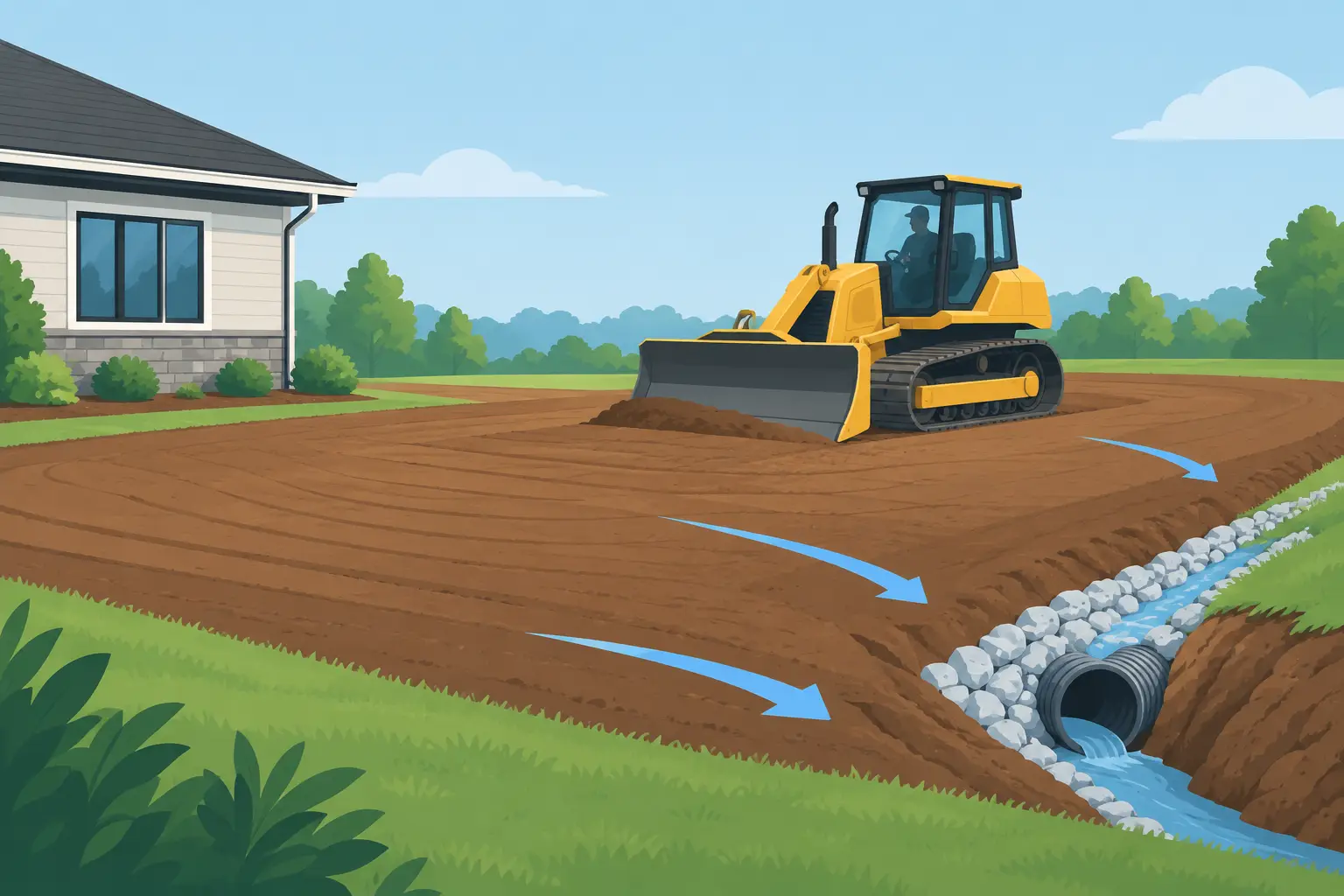
    Effective grading creates positive drainage. That means the surface slopes away from buildings and other critical improvements so water does not settle against them. The exact slope depends on the site, soil, existing structures, and available discharge area, but the direction of flow must be clear and continuous.

    Water needs a destination. A graded slope that sends runoff toward a dead-end low spot only relocates the problem. Depending on the property, runoff may need to reach a vegetated drainage area, stable swale, ditch, detention feature, approved drainage route, or a properly designed rock-lined channel. The right answer depends on terrain and local requirements.

    The grade also has to hold up. Bare dirt can look clean on day one and wash apart after the first heavy rain. Where water moves with speed or volume, the finish may need compaction, erosion-control material, rock, mulch, seed, vegetation, or drainage structures to keep the soil in place.

    Grading Land for Drainage Around Buildings

    Buildings are where drainage mistakes get expensive. Water held against a foundation can create moisture intrusion, frozen ground pressure, settlement concerns, and damage to finishes. It can also make access routes slick and unusable when temperatures drop.

    The ground immediately around a structure should shed water outward, without creating abrupt drops that are hard to maintain or unsafe to walk. Downspouts deserve attention too. A roof can concentrate a surprising amount of water in one small area. If that discharge lands beside the foundation or at the top of an unprotected slope, it can undermine the work below it.

    Do not assume adding soil against a building solves the problem. Raising grade too high can interfere with siding clearance, vents, window wells, utility equipment, and existing drainage details. A site needs enough fall to move water, but it also needs to respect the structure already in place.

    Driveways, Roads, and Access Need Their Own Plan

    A driveway is a drainage system whether it was designed as one or not. Water running down a road surface gains force fast. It carries gravel, creates ruts, cuts ditches, and can leave a property inaccessible when you need it most.

    Proper driveway grading sheds water off the travel surface before it runs the full length of the road. On some sites, that means a crowned surface that drains to both sides. On others, especially where a road crosses a slope, the road may need to drain to one controlled side. Ditches, rolling dips, water bars, culverts, and armored outlets may all have a role, but only if they fit the terrain and flow volume.

    Culverts are not a universal fix. An undersized, clogged, or poorly placed culvert can force runoff over the road or concentrate it into a destructive outlet. The inlet, outlet, alignment, cover depth, and erosion protection all matter. If the road crosses an active drainage path, get the drainage approach right before rebuilding the driving surface.

    Swales Move Water Without Making It a Problem Elsewhere

    A swale is a shallow, shaped channel that guides runoff across the land. It is often a better fit than a deep ditch for residential lots, cleared building sites, and open acreage because it can blend into the terrain while handling sheet flow.

    The key is consistent fall. A swale that is too flat can hold standing water. One that is too steep can become an erosion channel. Its outlet matters just as much as its shape. Water must leave the swale without scouring soil, flooding a lower use area, or crossing onto another property in a damaging way.

    Vegetated swales work well when conditions allow. Roots help hold soil, slow runoff, and filter sediment. In rocky or high-flow areas, a swale may need stone reinforcement at turns, inlets, outlets, or steep sections. The cleanest-looking option is not always the toughest option. Match the finish to the force of the water.

    Soil, Slope, and Season Change the Job

    Colorado soil can change dramatically across one property. Clay tends to drain slowly and can stay slick after a storm. Sandy soil may absorb water quickly but erode under concentrated flow. Rocky ground can make shaping difficult and expose material that needs a different finish than native soil.

    Steep slopes add another layer of risk. Cutting too aggressively into a hillside can destabilize soil, redirect runoff, or create a slope that cannot be safely maintained. Filling low ground without proper preparation can lead to settlement later. On significant slopes, near foundations, retaining features, or where large volumes of water are involved, a civil engineer or qualified drainage professional may be needed before field work begins.

    Timing matters as well. Grading before a forecasted storm without stabilizing exposed soil can create washouts immediately. Winter conditions can limit compaction and make finish grading difficult. A disciplined plan accounts for weather, access, soil moisture, and the order of operations.

    Clearing and Grading Work Better Together

    Overgrown vegetation can hide the real drainage pattern. Brush, deadfall, invasive growth, and accumulated debris may block swales, clog culverts, and trap runoff against fences or structures. Clearing those obstructions often reveals the actual shape of the ground.

    But clearing alone can increase runoff if roots and ground cover are removed without a follow-up plan. That is why site preparation should be coordinated. Clear the vegetation that blocks access or creates wildfire fuel, preserve useful stabilizing cover where possible, then grade and protect the disturbed areas.

    Yeti Defensible Landworks uses equipment built for rough Colorado ground to clear, mulch, shape, and prepare difficult sites. The work should leave the property safer and more usable, not trade one problem for another.

    Common Drainage Grading Mistakes

    The most common failure is grading toward the obvious low point without confirming whether that low point has a safe outlet. Another is making everything flat because flat ground looks finished. Flat ground often traps water.

    Property owners also run into trouble by directing runoff toward a neighbor, public right-of-way, septic area, or unstable slope. Drainage work can affect more than one parcel, and local rules may govern how runoff is handled. Check requirements before altering established drainage paths, installing culverts, or moving substantial soil.

    Finally, do not overlook erosion control. A freshly graded surface needs protection suited to the site. A drainage route that works during a light rain but fails during a Colorado downpour is not finished work.

    Know When to Bring in a Professional

    Small adjustments can be manageable when the problem is simple, the ground is gentle, and runoff has a clear, legal place to go. Larger drainage issues need more planning. Bring in experienced help when water threatens a structure, crosses a driveway, cuts a slope, ponds repeatedly, involves a culvert, or affects neighboring land.

    The right crew starts by reading the property, not by pushing dirt at the first wet spot. They identify flow paths, shape the grade with purpose, protect vulnerable soil, and leave access routes and work areas ready for use.

    Water will follow gravity every time. Give it a controlled route now, and your land stays firmer, safer, and ready for whatever comes next.

  • Land Preparation Before Construction Starts

    Land Preparation Before Construction Starts

    A building site can look ready from the road and still hide the problems that burn time and money once equipment arrives. Dense brush, buried debris, soft ground, steep approaches, drainage paths, and poor staging space can all slow a project before the first footing is laid. Land preparation before construction puts those problems in the open and gives the build a solid place to start.

    For Colorado property owners, this work is rarely just about making a lot look cleaner. It is about creating safe access, managing wildfire fuels, controlling water, and giving contractors room to work without fighting the terrain every day. Done right, site prep reduces surprises. Done halfway, it can create expensive ones.

    What Land Preparation Before Construction Actually Includes

    Land preparation is the field work required to turn raw, neglected, or difficult ground into a usable construction site. The exact scope depends on the property, the planned structure, local requirements, and the time of year. A flat infill lot in Denver needs a different approach than a wooded mountain parcel, a rural driveway extension, or a future home site on acreage.

    Most projects begin with clearing unwanted vegetation and obstacles. That can include brush, small trees, deadfall, invasive growth, old fence material, slash piles, stumps, surface rock, or abandoned debris. The goal is not to scrape every inch of land bare. The goal is to clear only what the project needs while protecting stable soil, mature trees worth keeping, and the natural features that matter.

    After clearing comes access and usable work space. Construction crews need a safe way in, a place to turn around, and room to stage materials and equipment. On rugged properties, improving an approach road or establishing a stable equipment path can be just as important as clearing the building pad itself.

    Grading is the next major piece. It shapes the site for drainage, building elevation, access, and practical use. Sometimes that means rough grading a pad. Other times it means correcting ruts, smoothing a work area, directing surface water away from the future structure, or restoring disturbed ground after heavy work is complete.

    Start With the Ground, Not the Building Plan

    A site plan tells you where the structure goes. The ground tells you what it will take to get there. Before mobilizing equipment, walk the property with the actual project in mind. Identify the planned building location, driveway route, utility path, drainage areas, slopes, mature trees, property lines, and any areas that need to remain undisturbed.

    This early look often changes the work plan. A proposed access route may be too steep for regular truck traffic. A low spot may hold seasonal water. Heavy brush may conceal rock outcrops, old wire, or uneven ground. Catching these conditions before construction starts is cheaper than discovering them after concrete, lumber, or delivery trucks are already on site.

    Call utility-locating services before digging or grading. If the property has existing power, water, gas, communications lines, septic components, or irrigation, mark them clearly and build the work plan around them. Never assume a line is shallow, accurately mapped, or out of the way.

    Permits and local rules also belong at the front of the process. Clearing, grading, driveway work, drainage changes, tree removal, and disturbance near waterways may require approvals. In mountain and rural areas, access, erosion, and wildfire mitigation standards can affect the scope. Confirm the requirements before the equipment shows up, not after work has begun.

    Clear Vegetation Without Creating a Bigger Problem

    Overgrown vegetation can block access, hide hazards, and load a property with wildfire fuel. But clearing needs control. Pushing brush into piles or stripping soil with the wrong equipment can leave exposed dirt, drainage problems, and disposal headaches.

    Forestry mulching is often a strong fit for brush, small trees, and dense understory. A drum mulcher processes vegetation into mulch on the ground rather than creating haul-off piles across the property. That mulch can help protect exposed soil, reduce erosion, and make the site easier to manage. It also breaks up continuous fuel beds, which matters on Colorado properties where wildfire exposure is part of the planning picture.

    Mulching is not the right answer for every condition. Large trees, substantial stumps, construction debris, heavy rock, and material that must be removed from the site may require different methods. A good contractor matches the machine and the approach to the ground instead of forcing one solution across the entire property.

    Keep a clear line between site preparation and indiscriminate clearing. Retaining healthy trees in the right locations can provide shade, wind protection, privacy, and slope stability. The target is a clean, workable site with reduced hazards, not a scarred piece of ground that becomes harder to build on.

    Build Access That Can Handle the Job

    A narrow, soft, or overgrown approach can become the first serious construction delay. Delivery trucks, excavation equipment, concrete vehicles, and crews all need dependable access. If the road fails under traffic, the entire schedule takes a hit.

    Start by considering the largest and heaviest equipment that will need to reach the site. That determines needed width, overhead clearance, turning room, slope management, and surface condition. Low limbs, brush, loose soil, washouts, and sharp turns can all limit access long before a truck reaches the building pad.

    On acreage and mountain properties, access improvements may include clearing corridor vegetation, widening tight sections, repairing ruts, shaping drainage, and establishing a stable route to the work area. Water is the enemy of weak roads. A route that appears solid during dry weather may become unusable after runoff or spring thaw if water has nowhere to go.

    Do not overlook emergency access. A practical route improves day-to-day construction logistics, but it also gives first responders a better chance of reaching the property if something goes wrong.

    Grade for Water Before Water Finds Its Own Route

    Water will move through a site whether it was planned for or not. The job of grading is to give it a controlled path that protects the future structure, access route, and surrounding ground.

    Rough grading establishes the broad shape of the site. Fine grading comes later, when final elevations and finish surfaces are known. For early construction work, the focus is usually creating a stable pad, keeping water away from the proposed foundation area, and avoiding channels that wash through drive lanes or staging zones.

    This is where shortcuts cause trouble. Moving soil without understanding the slope can send runoff toward the building area, neighboring land, a road, or a drainage feature. Cutting too aggressively into a hillside can destabilize the ground. Filling low areas without proper compaction can create settlement issues later.

    The right grade depends on the project. A small outbuilding may need a straightforward pad and drainage path. A new home, commercial site, or development parcel may require engineered plans, compaction standards, and more precise earthwork. Know where general site prep ends and engineered work begins.

    Plan the Work in the Right Order

    Site preparation is more efficient when each phase supports the next one. Clearing access after materials arrive, for example, puts the project backward. The usual sequence is to confirm boundaries and utilities, establish access, remove vegetation and obstacles, create a work area, complete rough grading, and then prepare for the next trade.

    Weather can change that sequence. Wet soil may not support equipment without damage. Frozen ground can limit grading. Fire restrictions may affect operations during dry periods. A disciplined plan leaves room for real field conditions instead of promising a one-size-fits-all timeline.

    Yeti Defensible Landworks approaches difficult Colorado ground with high-flow compact track loader power, drum mulching capability, and a direct focus on safe, usable results. The work is built around the conditions on site: clear what needs clearing, improve what needs improving, and leave the property ready for the next move.

    Do Not Treat Cleanup as an Afterthought

    The best-prepared site is not simply cleared. It is organized. Material piles are handled, loose debris is removed, access remains open, and disturbed ground is left in a condition that makes sense for the next phase.

    Before the crew leaves, walk the site and compare it to the original plan. Confirm the pad area is accessible, routes are clear, drainage has not been blocked, protected areas remain intact, and no new hazards were created. If construction will not start immediately, consider whether exposed soil, mulched areas, or cleared corridors need temporary erosion control or periodic maintenance.

    A clean site does more than look professional. It lets the next contractor arrive, set up, and work without wasting the first day solving preventable problems.

    The right land preparation gives a project momentum before the foundation work begins. Walk the property early, make the hard calls before equipment and materials stack up, and build the site around safe access, stable ground, and water control. That is how difficult Colorado land becomes ground you can build on.

  • Lot Clearing Services That Prepare Land Right

    Lot Clearing Services That Prepare Land Right

    A lot can look manageable from the road and still be a problem once you step into it. Dense brush hides rock, deadfall blocks access, small trees crowd usable ground, and dry vegetation adds fuel where you do not want it. Professional lot clearing services turn that rough, overgrown ground into land you can inspect, maintain, build on, or defend.

    For Colorado property owners, clearing is rarely just about making a site look better. It is about gaining control of the property. That may mean reducing wildfire fuels around a home, opening a driveway route, preparing an undeveloped parcel for construction, or reclaiming acreage that has been neglected for years.

    What Lot Clearing Services Actually Do

    Lot clearing is the removal and management of unwanted vegetation and obstructions so land can serve a practical purpose. The work may include brush removal, small-tree clearing, invasive vegetation control, forestry mulching, deadfall cleanup, access clearing, rough grading, and site preparation.

    The right scope depends on the ground and the goal. A wooded mountain lot being prepared for defensible space needs a different approach than a Front Range parcel being opened for a shop pad or new home. Clearing every living thing is not always the answer. In many cases, the better result is selective removal that keeps healthy, well-spaced trees while eliminating ladder fuels, dense understory, and problem vegetation.

    A capable crew starts by reading the site. Slope, drainage, soil conditions, rock, utility locations, tree density, and equipment access all affect the plan. Good work protects the parts of the property worth keeping while removing what creates risk or gets in the way.

    When It Is Time to Clear Your Lot

    Property conditions tend to worsen slowly, then become obvious all at once. A driveway that was barely passable becomes blocked. Brush spreads into a fence line. Dead material stacks up beneath trees. A project is ready to start, but nobody can get equipment where it needs to go.

    Lot clearing is usually the right call when vegetation limits access, obscures property boundaries, increases fire exposure, or prevents construction and maintenance. It is also useful before selling land, installing utilities, repairing drainage, building fences, creating trails, or preparing for excavation.

    Wildfire mitigation is a major driver across Colorado. Thick brush, low branches, deadfall, and tightly packed small trees can carry fire across a property and toward structures. Clearing fuels around homes, outbuildings, driveways, and access routes gives firefighters more room to work and helps create a more defensible property condition.

    There is a practical side, too. Overgrowth holds moisture, hides hazards, and makes routine upkeep harder. Once the ground is opened up, owners can see grades, drainage paths, retaining needs, fence damage, and areas that need restoration. Clear land is easier to manage because problems are no longer buried under vegetation.

    Forestry Mulching Versus Traditional Clearing

    Forestry mulching is often one of the strongest tools for lot clearing work, especially on properties with brush, saplings, and dense understory. A compact track loader with a drum mulcher cuts and processes vegetation into mulch directly on the ground. Instead of hauling piles away or burning slash, the material is left as a low-profile layer that can help reduce erosion and retain moisture.

    That does not mean mulching is right for every job. If a property needs building pads, trenching, deep root removal, major excavation, or large-tree removal, additional equipment and follow-up work may be required. Mulching handles vegetation efficiently, but it does not replace a full earthwork plan.

    Traditional clearing methods can also make sense where material must be removed from the site, where vegetation is too large for a mulcher, or where a clean mineral-soil finish is required. The key is matching the method to the next step. If the lot is being prepared for a house, a driveway, or a commercial build, the clearing plan needs to work with the grading and construction plan that follows.

    Avoid the mistake of choosing a method based only on what appears cheapest at first. A rushed clearing job can leave stumps in the wrong places, create erosion issues, damage retained trees, or make the next contractor’s work harder. The goal is not simply to knock vegetation down. The goal is to leave the site ready for its intended use.

    What a Strong Clearing Plan Looks Like

    A solid plan starts with a clear finish line. Tell the contractor what needs to happen after clearing. Are you reducing wildfire fuels around a home? Establishing a driveway? Opening a future building envelope? Cleaning up acreage for grazing, fencing, or regular maintenance? That answer determines how far clearing extends, what stays, what goes, and whether grading or restoration is part of the work.

    Property access matters early. Compact tracked equipment can work effectively on uneven terrain and in tighter areas, but it still needs a safe route in and out. Gates, bridges, soft ground, steep slopes, overhead limbs, and nearby structures all need to be considered before mobilization.

    Utilities and boundaries also need attention. Owners should identify known utility lines, easements, septic components, wells, irrigation infrastructure, and survey markers before work begins. If boundaries are unclear, get them resolved before clearing starts. It is far easier to protect a boundary marker than replace one after the ground has been opened up.

    Finally, decide what happens to the material. Mulch can stay on site when it fits the property goals. Wood, slash, debris, and unsuitable material may need to be piled, hauled, or processed differently. There is no one-size-fits-all answer. The best approach is the one that leaves a safer, cleaner site without creating a new maintenance burden.

    Questions to Ask Before Hiring Lot Clearing Services

    Do not hire based on a vague promise to “clear it out.” Ask how the contractor plans to handle the vegetation, what equipment will be used, and what the finished condition will look like. The answers should be direct.

    You should also ask whether the crew has experience with Colorado terrain, wildfire-fuel reduction, tight access, and selective clearing around structures. A contractor who understands defensible space knows that spacing, ladder-fuel removal, and access routes matter just as much as raw acreage cleared.

    Ask for clarity on what is included. That means the work area, vegetation size and type, debris handling, stump treatment if needed, travel conditions, grading limits, and site cleanup. A clear scope prevents surprises and makes it easier to compare proposals fairly.

    Equipment matters, but operator judgment matters more. High-flow compact track loaders and drum mulchers bring serious production to rough ground, yet they need an experienced operator who can work close to retained trees, fences, structures, and changing terrain without creating unnecessary damage. Veteran-owned Yeti Defensible Landworks brings that disciplined, safety-first approach to projects across its Colorado service area.

    Clearing for Fire Safety, Access, and Build-Ready Ground

    The strongest lot clearing projects solve more than one problem. A properly cleared driveway corridor can improve everyday access and provide a better route for emergency equipment. Selective thinning around a home can reduce wildfire fuels while opening views and making the property easier to maintain. Clearing an undeveloped lot can expose the land needed for a real site plan instead of forcing decisions based on guesswork.

    There are trade-offs. Removing too much vegetation can increase erosion, reduce privacy, and expose soil to harsh sun and weather. Removing too little can leave the property just as difficult to use. This is why selective, purpose-driven clearing usually delivers a better long-term result than indiscriminate removal.

    On sloped or disturbed ground, restoration should be part of the conversation. Mulch coverage, drainage control, reseeding, and erosion measures may be needed after clearing. The right follow-up protects the investment and helps the land settle into a stable, manageable condition.

    If your property has become overgrown, hazardous, or hard to reach, do not wait for the next fire season, building deadline, or access failure to force the issue. Walk the ground, define the outcome you need, and bring in a crew equipped to clear it with control. Good land work gives you more than an open lot. It gives you a property you can use with confidence.

  • Construction Site Clearing for a Solid Start

    Construction Site Clearing for a Solid Start

    A build does not start when concrete arrives. It starts when crews and equipment can safely reach the work area, move through it, and work on stable ground. Construction site clearing handles that first hard step by removing the brush, small trees, debris, and rough vegetation that stand between raw land and a workable jobsite.

    On Colorado acreage, that work often does more than make room for a building pad. It can open a blocked driveway, reduce dense wildfire fuels around future structures, expose drainage concerns, and give owners a clear view of what their land actually needs. Done right, clearing creates a clean starting point without tearing up more ground than the project requires.

    What Construction Site Clearing Should Accomplish

    Site clearing is not simply knocking down vegetation and leaving piles behind. The goal is a site that supports the next phase of work, whether that is surveying, excavation, utility installation, grading, fencing, or construction.

    A properly scoped clearing job removes unwanted brush, saplings, deadfall, invasive growth, slash, scattered debris, and other obstacles within the planned work area. It also establishes usable access for trucks, trailers, compact equipment, and crews. On a rural lot, that may mean reclaiming an old two-track road before any actual building-site work begins.

    The right finish depends on the project. A future home site may need a clean footprint and access route while preserving mature trees outside the build zone. A commercial parcel may require broader clearing to support utility trenching, staging, and grading. A wildfire-mitigation project may focus on thinning and mulching fuels rather than removing every tree.

    That distinction matters. Over-clearing wastes money, exposes soil, and can create erosion problems. Under-clearing leaves obstacles that slow the next contractor down. The best approach is precise: clear what the project needs, protect what should stay, and leave the property ready for the work ahead.

    Start With the Ground Conditions

    Before machines move in, walk the property with the full project in mind. Mark the intended driveway, building area, utility routes, drainage paths, and any trees or features that need protection. A little planning prevents expensive rework after the ground is opened up.

    Identify Access Before the Main Work Begins

    Access is often the first real challenge on Colorado properties. A steep entry, narrow gate, soft shoulder, tight switchback, or overgrown lane can keep larger equipment from reaching the site. Clearing access may involve trimming vegetation, removing small trees, widening a route, addressing low-hanging limbs, or improving the travel surface.

    Do not assume an existing road is ready for construction traffic just because a pickup can get through. Delivery trucks, dump trailers, excavators, and concrete trucks need room to turn, pass, and stay on stable ground. If access will not support the equipment needed later, solve that problem early.

    Watch Water, Slope, and Soil

    Vegetation can hide drainage swales, rocky outcrops, washouts, and changes in grade. Once clearing begins, those conditions become easier to see and address. They can also change how the work should proceed.

    On sloped ground, aggressive disturbance can send soil downhill during the next heavy rain. In wet or soft areas, heavy equipment can rut the site and create problems that require additional grading. Clearing methods, travel routes, and timing should match the terrain. Sometimes the smart move is to wait for drier conditions. Other times, a compact track loader is the better fit because it can work effectively while spreading its weight across a wider footprint.

    Know What Must Stay

    Good site preparation is selective. Flag retained trees, property boundaries, septic areas, utility corridors, drainage features, and structures before clearing starts. If there are overhead lines or buried utilities, confirm their location before digging, pulling, or grading.

    Mature trees deserve special attention. Their roots can extend well beyond the visible canopy, so running equipment too close or changing the grade around them can cause damage that shows up months later. If a tree is meant to remain, give it room and plan equipment paths around it.

    Choose the Right Clearing Method

    There is no one-size-fits-all method for construction site clearing. The right equipment depends on vegetation size, terrain, disposal needs, intended finish, and the next step in the project.

    Forestry mulching is often a strong option for brush, small trees, thick understory, and overgrown access routes. A high-flow compact track loader with a drum mulcher can process vegetation in place, leaving a mulch layer across the soil rather than creating burn piles or hauling large volumes of material away. That mulch can help reduce erosion and keep soil covered, particularly on slopes.

    Mulching is not always the final answer. If a building footprint requires stumps and root systems removed, excavation and grading may be needed after vegetation is cleared. If the site contains construction debris, metal, large rock, or hazardous material, those items must be handled separately. A mulcher is built for vegetation, not hidden junk buried in weeds.

    Mechanical removal can make sense where the project needs a fully cleared pad, utility trench, or road base. It may include cutting, pulling, hauling, stump work, rough grading, and material disposal. This approach is more disruptive than mulching, but it can be necessary when the land must be reshaped or built on immediately.

    The practical answer is often a combination: mulch the surrounding fuels, clear and remove vegetation inside the building envelope, improve access, then grade the disturbed areas for the next contractor.

    Construction Site Clearing and Wildfire Risk

    In many Colorado mountain, foothill, and rural properties, site clearing also creates an opportunity to reduce wildfire exposure. Dense brush, ladder fuels, deadfall, and small conifers can carry fire toward a future home, barn, shop, or equipment yard.

    Clearing for construction should not ignore that reality. As access is opened and a site is prepared, it makes sense to evaluate the vegetation around planned structures, driveways, turnaround areas, and emergency routes. Removing concentrated fuels and creating workable defensible space can improve both fire readiness and day-to-day property management.

    This does not mean stripping a lot bare. Healthy land still needs shade, screening, habitat, and soil stability. The goal is to break up continuous fuel, remove problem growth, and maintain separation between vegetation and structures. A property can look natural while being far more manageable and safer.

    Common Mistakes That Create Delays

    The most expensive clearing mistakes tend to happen before the work starts. Owners sometimes clear a broad area without a site plan, then discover they removed trees needed for screening or failed to clear the actual utility route. Others focus only on the building pad and leave no room for equipment staging, material storage, or truck turnaround.

    Burning or piling vegetation without a clear disposal plan can also create a bottleneck. Depending on local conditions and restrictions, burning may not be practical. Hauling can add cost and time. On suitable sites, mulching reduces the material-handling problem by processing vegetation where it stands.

    Another common issue is skipping rough grading after clearing. Once brush and small trees are gone, the site may still have ruts, exposed roots, holes, uneven approaches, and drainage issues. Clearing and grading are different tasks, but they should be planned together when the goal is a build-ready site.

    What to Expect From a Professional Crew

    A capable contractor should ask direct questions before quoting the work: What is being built? Where does equipment need to travel? What vegetation stays? Is the goal wildfire mitigation, access, a building pad, or all three? Are there utilities, steep slopes, drainage concerns, or material that cannot be mulched?

    The crew should arrive with equipment matched to the property rather than forcing a standard approach onto every job. Compact track loaders and forestry mulchers are especially effective on rough, brush-heavy ground where maneuverability matters. They can work through difficult terrain, clear tight areas, and produce visible results without the broad disturbance of larger clearing operations.

    Yeti Defensible Landworks approaches site work with that same discipline: clear the problem, protect the usable ground, and leave the property ready for what comes next.

    A clean site is not just a better-looking site. It gives surveyors clear lines, lets trades move safely, exposes issues before they become change orders, and puts the project on solid ground. Plan the clearing around the work that follows, and the land will stop being the obstacle.