
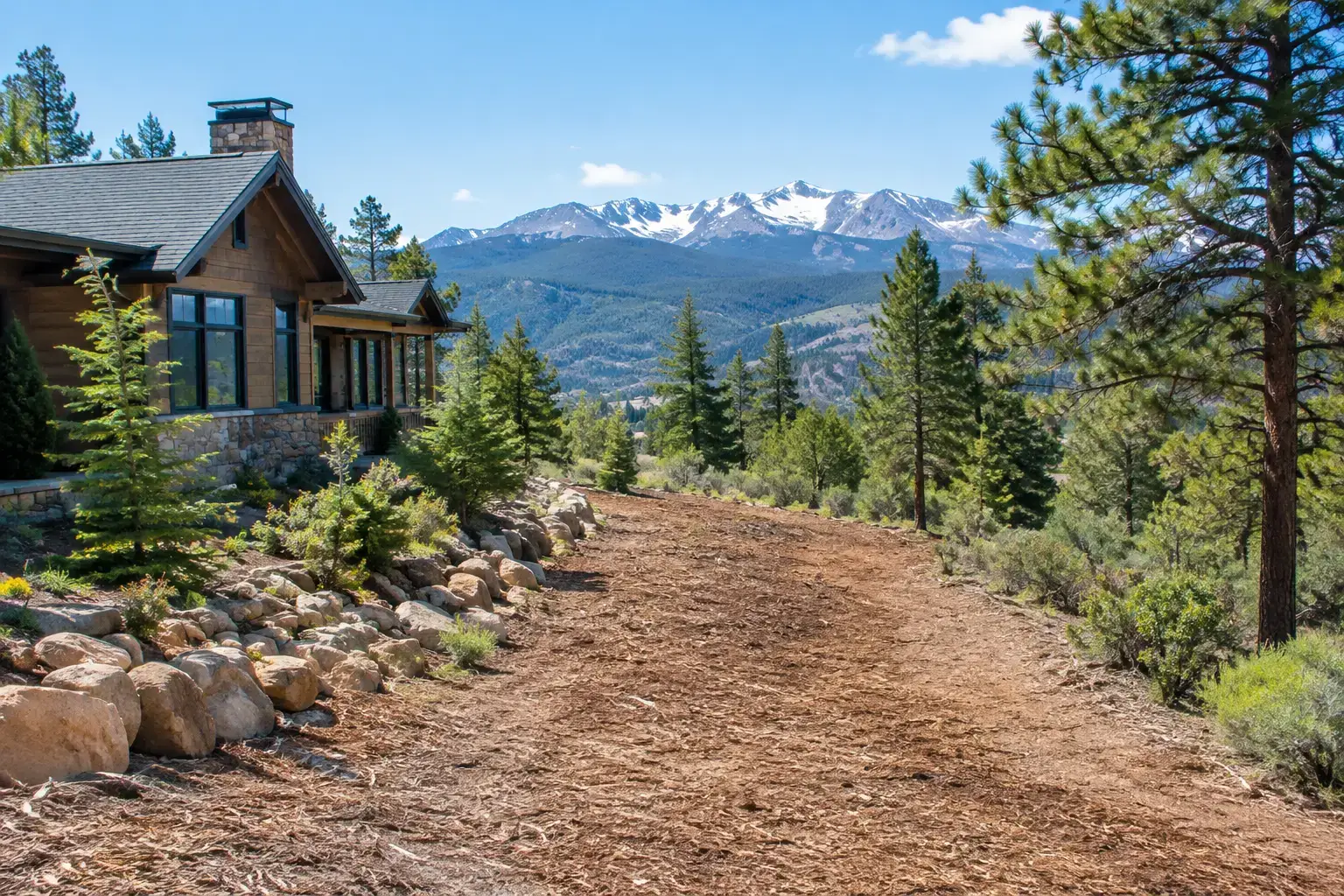
A firebreak is not just a cleared strip around the edge of a property. The right firebreak options reduce the fuel available to a moving wildfire, give crews room to work, and make your land easier to manage long after the job is done. The wrong approach can leave bare soil washing downhill, create a false sense of security, or clear ground that did not need to be disturbed.
For Colorado acreage, mountain homes, ranch entrances, and rural developments, the best answer usually is not one wide line scraped to dirt. It is a connected fuel-reduction plan built around vegetation, slope, structures, roads, and access. Clear what feeds fire. Keep the ground stable. Build practical space for response and maintenance.
Start With the Job the Firebreak Must Do
A firebreak can mean several different things. On one property, it may be a low-fuel strip along a driveway that lets a fire engine reach the home. On another, it may be a widened zone between dense brush and a barn, shop, fence line, or neighboring timber. Larger parcels may need strategic breaks along ridges, property boundaries, roads, and access routes.
The goal is not to guarantee that wildfire cannot cross the line. Wind-driven embers can travel far beyond any cleared area. The goal is to interrupt continuous fuels, reduce flame length near assets, and create safer working conditions for suppression crews. That takes more than cutting vegetation to the same height everywhere.
Walk the property before choosing a method. Look for ladder fuels that carry fire from grass and brush into low branches. Identify heavy pockets of gamble oak, juniper, pine regeneration, deadfall, tall grass, and invasive growth. Pay close attention to uphill slopes, drainages, fence corners, sheds, propane tanks, woodpiles, and narrow roads. Those are the places where fire behavior and access problems often stack up.
Firebreak Options That Fit Colorado Ground
Forestry mulching for thick brush and small trees
Forestry mulching is often the most practical choice for overgrown acreage, steep ground, and areas where hauling or burning debris would be difficult. A drum mulcher cuts brush and small trees into chips and spreads the material across the ground. That reduces vertical fuel, removes dense brush cover, and leaves a more stable surface than full-scale excavation.
Mulching works especially well when the objective is a shaded fuel break or defensible-space zone rather than a bare-earth fire line. It keeps roots in place, limits soil disturbance, and can turn tangled vegetation into manageable ground in a single pass.
The trade-off is maintenance. Mulch is still organic material. If it is left too deep or applied in a continuous blanket beside a structure, it can carry fire. A professional operator should manage the depth, pull material away from buildings and critical features, and avoid treating every area the same way. Mulching also does not replace pruning, removal of hazardous trees, or cleanup of large dead material when those conditions are present.
Hand thinning for selective work near valuable trees
Hand thinning is slower, but it gives the most control around mature trees, landscaping, utility lines, rock outcrops, fencing, and tight spaces. Crews can remove ladder fuels, dead branches, dense saplings, and individual problem trees while protecting the vegetation worth keeping.
This option makes sense near homes, cabins, historic structures, and areas with uneven terrain that cannot safely support equipment. It is also useful where a property owner wants to preserve a specific look while still opening up the understory and breaking up fuel continuity.
The limitation is production speed. Hand work costs more per acre than equipment-based clearing and creates slash that must be chipped, hauled, piled where allowed, or otherwise managed. It is best used as a precise tool within a broader plan, not as the only answer for a heavily overgrown ten-acre parcel.
Mowing and brush cutting for grass and light growth
Mowing and brush cutting can create effective low-fuel strips in grassland, along driveways, around outbuildings, and beside fences. This is a clean option for lighter vegetation that regrows quickly, especially on flatter, accessible terrain.
Timing matters. Cutting tall grass before peak fire season lowers flame height, but dry clippings left in place can still burn. Where practical, remove or disperse cut material so it does not form a windrow of fine fuels. Keep blades and equipment maintained, and avoid running machinery in hot, dry, windy conditions when sparks or overheated components could start a fire.
Mowing alone is not enough for dense shrub fields or small-tree thickets. It handles surface fuels well, but it will not solve ladder fuels or open up a blocked access route.
Mineral-soil breaks for high-risk edges and operational access
A mineral-soil break removes vegetation and organic material down to exposed soil. This is the closest thing to a traditional fire line. It can be useful along a road, around a work area, beside a fuel storage location, or at a strategic perimeter where land managers need a hard separation between fuels.
It is also the most disruptive option. Bare ground can erode fast on Colorado slopes, particularly after heavy rain or spring runoff. It may create drainage problems, damage roots, spread weeds, and require grading or stabilization. A scraped line across every hill is rarely a smart long-term plan.
Use mineral-soil breaks selectively. Pair them with water-control features, stable grading, and revegetation where appropriate. On many properties, a maintained road or dozer-width access lane combined with thinned vegetation provides more value than a long strip of exposed dirt.
Access lanes and roads that serve two purposes
A well-built access lane can function as both a fuel break and a working route for equipment, maintenance, and emergency response. Widening clearance along a driveway, removing overhanging limbs, cutting brush back from road edges, and improving turnarounds can make a major difference when time matters.
This option is particularly valuable for rural homes with one way in and one way out. A narrow driveway enclosed by brush may trap heat, block visibility, and limit emergency access. Clearing the corridor improves everyday usability while reducing the fuels that sit directly beside the route.
Road work needs discipline. Poor drainage and soft shoulders can make access worse, not better. Grade for water movement, stabilize weak sections, and make sure the route is wide enough for the equipment and vehicles that may need to use it.
Width Depends on Fuel, Slope, and What You Are Protecting
There is no responsible one-size-fits-all width for a firebreak. A narrow mowed strip may be useful in short grass on level ground. Dense brush on a steep, south-facing slope may require a much wider treated zone, thinning beyond the break, and additional defensible space around structures.
Fire travels faster uphill. Flames preheat vegetation above them, so the fuel break on the uphill side of a home, barn, or access road often needs more attention. Wind exposure matters too. Open ridges and canyon mouths can push embers and flame farther than a calm site would suggest.
Think in layers. Start with the immediate area around buildings, where combustible debris, stacked firewood, vegetation, and flammable materials need close control. Then extend treatment outward by removing brush clumps, separating tree crowns where appropriate, and reducing the continuity of grass, shrubs, and low branches. Finally, build strategic breaks along roads, ridges, and property edges where they support access or slow a fire moving toward the site.
Avoid the Common Mistakes
The biggest mistake is treating a firebreak as a finished project that never needs attention. Grass returns. Brush resprouts. Wind drops limbs. Pine needles gather against buildings. A fuel break that is not maintained becomes another continuous fuel bed.
Another mistake is clearing too aggressively. Removing every tree can expose soil, increase erosion, and reduce the shade that helps retain moisture. The goal is safer spacing and lower fuel loading, not a stripped landscape. Selective thinning and mulching usually preserve more value than indiscriminate clearing.
Finally, do not overlook the material created by the work. Slash piles, chipped debris, cut branches, and stacked logs need a plan. Keep combustible material away from structures, utilities, and access routes. If large material must remain, place it where it will not create a direct path for fire into the assets you are protecting.
Build a Firebreak That Works After the Crew Leaves
The best firebreak options improve more than wildfire readiness. They open access, make fence repair easier, create usable building pads and trail corridors, improve visibility, and make future maintenance faster. That is why equipment choice and finish quality matter.
For dense, difficult Colorado ground, Yeti Defensible Landworks combines high-flow compact track loader capability with drum mulching and practical site work. The objective is clear: reduce fuels without making a bigger land-management problem.
Start with the area that matters most – the route in, the structure zone, the uphill brush, or the overgrown edge where fire would gain momentum. A focused first phase can protect the property now and give you a solid plan for the rest of the ground.
Leave a Reply