
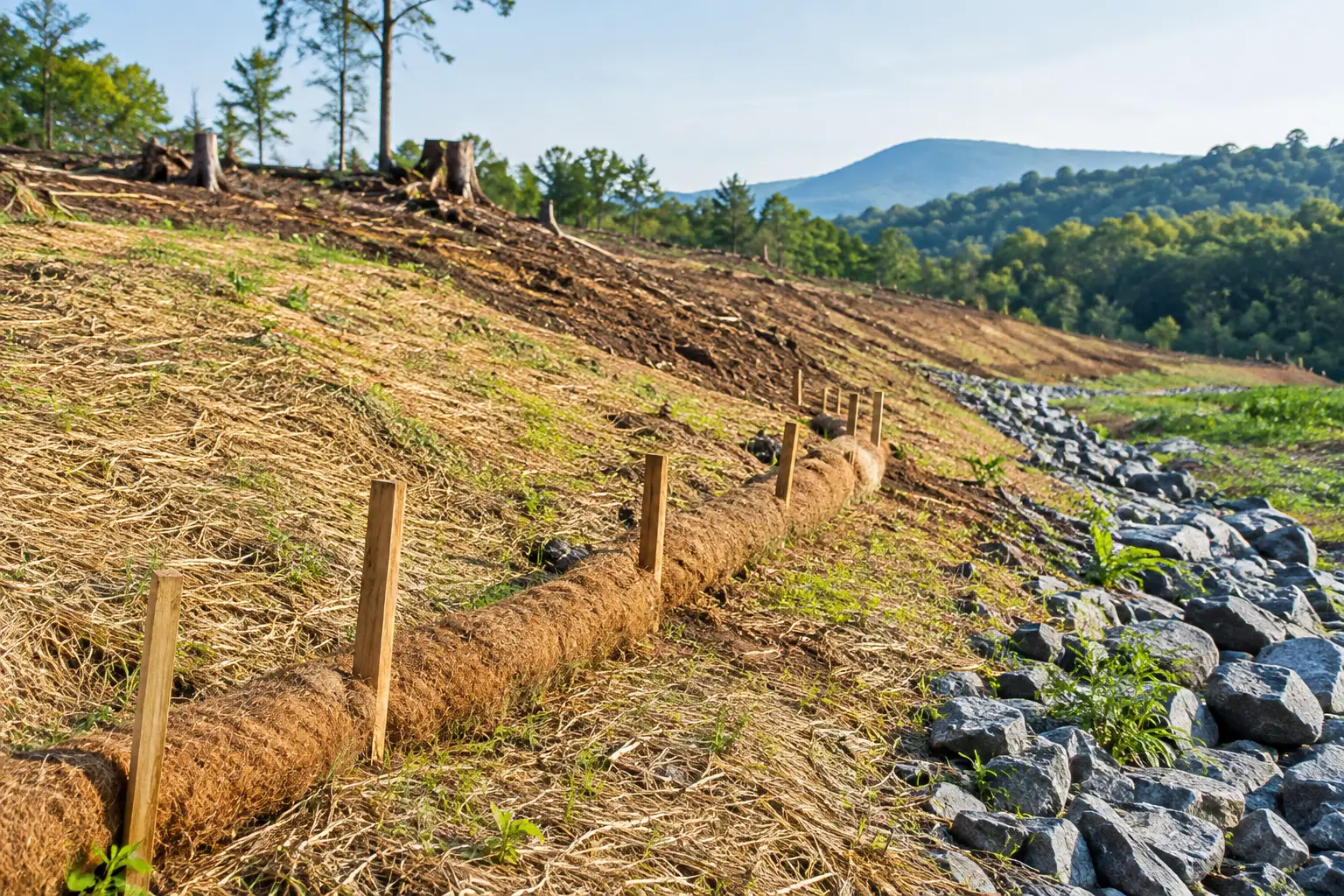
A cleared property can look finished on the day the equipment rolls out. Then a hard Colorado thunderstorm hits, and water finds every exposed slope, wheel track, ditch, and loose edge. Topsoil moves fast. Driveways rut. Sediment collects where it does not belong.
To prevent erosion after clearing, the job cannot stop at removing brush, small trees, and wildfire fuels. The ground needs a plan for water. That plan should match the slope, soil, drainage patterns, intended use, and the season when work is completed.
Why Cleared Ground Can Erode Fast
Vegetation does more than make land look overgrown. Roots help hold soil in place. Leaf litter and grass slow rainfall before it strikes the ground. Brush can also interrupt surface runoff, even when that brush is a wildfire fuel problem that needs to go.
Once land is cleared, bare soil is exposed to direct rain, snowmelt, wind, and runoff. This is especially true on foothill lots, mountain properties, rural acreage, and construction-ready sites with uneven terrain. Colorado soils can be dry and hard at the surface, then shed water during a sudden storm instead of absorbing it.
Forestry mulching helps reduce that exposure because it leaves a protective layer of chipped vegetation across the soil. But mulch is not a cure-all. Steep slopes, concentrated drainage, loose disturbed soil, and vehicle traffic can still create erosion problems if the site is not shaped and stabilized correctly.
Start With Water, Not Just Vegetation
Before clearing begins, identify where water already goes. Look for low spots, existing ruts, swales, culverts, drainage crossings, and areas where runoff leaves the property. A clear path for water is better than water cutting its own path through fresh ground.
The goal is not always to stop water. That is rarely realistic and can create problems elsewhere. The goal is to slow it down, spread it out where appropriate, and move concentrated flow through stable areas.
On a relatively flat lot, simple surface grading and mulch coverage may be enough. On a sloped property, a road cut, or land below a driveway, the work may require more deliberate measures such as drainage swales, rolling dips, water bars, rock-armored outlets, or properly sized culverts. The right approach depends on the grade and the volume of runoff expected during heavy weather.
Do not direct runoff toward a neighbor, a structure, a septic area, or an unstable slope. Solving erosion in one spot by sending water somewhere worse is not a solution.
Keep Drainage Features Clear
New drainage features only work if they remain open. Mulch, slash, loose dirt, and rocks can block a shallow swale or ditch after the first storm. Where clearing occurs near a driveway or access road, make sure culvert inlets and outlets are protected and easy to inspect.
This matters most at transitions. Water often causes damage where a gravel drive meets native ground, where a slope reaches a flat area, or where runoff exits a culvert at speed. Those locations deserve extra stabilization before the weather tests them.
Use Mulch to Protect the Soil Surface
Forestry mulch is one of the most practical tools to prevent erosion after clearing. A consistent layer reduces rain impact, holds moisture, moderates soil temperature, and gives the ground time to recover. It also keeps freshly cleared land from looking stripped and raw.
The key is coverage. Thin, scattered chips may not do much during a hard rain. Heavy piles can smother desirable vegetation or divert runoff in the wrong direction. A controlled, even mulch layer is usually the better outcome, especially across open slopes and around the edges of defensible-space work.
Mulch works best where it stays in place. On moderate terrain, a drum mulcher can process brush and small trees into material that follows the natural contours of the land. On steep slopes or areas with concentrated flow, mulch may need backup from erosion-control blankets, wattles, rock, or other site-specific stabilization.
Avoid pushing piles of mulch into drainage channels. When material catches runoff, it can form a temporary dam, then release water and debris all at once when it fails.
Grade for Stable Slopes and Usable Access
Clearing often exposes problems that dense vegetation had hidden: old fill, soft shoulders, washouts, uneven pads, and poorly built access routes. Address them while equipment is already on site.
A stable grade sheds water without sending it downhill in a straight, fast-moving line. Long uninterrupted slopes are vulnerable because runoff gains speed and carrying force as it travels. Breaking up that flow with contour grading, shallow diversions, or stable vegetated areas reduces the chance of rills turning into gullies.
Driveways need special attention. A driveway is both an access route and a drainage structure. If its crown, cross-slope, ditches, and outlets are wrong, every storm can pull gravel and soil down the road. Good access improvements move water off the driving surface early and release it into protected areas.
Do not overgrade a property just to make it look smooth. Excessive disturbance removes stable ground cover and creates more exposed soil than the job requires. Precision work protects the usable site while leaving stable areas alone.
Reestablish Ground Cover Before Weather Takes Over
Bare soil is temporary ground. The sooner it has living cover again, the better. Native or locally suitable seed, grasses, and low-growing plants can rebuild root structure and improve water infiltration over time.
Timing matters in Colorado. Seeding just before favorable moisture can improve establishment, while seeding into hot, dry conditions without a watering plan may produce weak results. Higher elevations, windy sites, south-facing slopes, and disturbed clay soils all require realistic expectations. Seed does not become a finished cover overnight.
Use mulch to support germination where appropriate, but do not bury seed under a thick mat. For higher-risk slopes, erosion-control blankets can hold seed and soil in place until vegetation establishes. On some projects, the correct call is to stabilize the ground immediately, then seed during the next suitable planting window.
If invasive plants were part of the original clearing problem, watch the site closely. Disturbed ground gives aggressive weeds an opening. Early follow-up treatment is far easier than letting invasive vegetation reclaim a newly cleared area.
Protect the Site From Traffic and Fast Runoff
Freshly cleared ground is easy to damage. Track marks, repeated truck traffic, and equipment turns can compact soil or create channels that collect water. Keep traffic on planned access routes until the property is stable.
For active construction sites, coordinate clearing, grading, and erosion control in the right order. Clearing too far ahead of the next phase leaves exposed ground sitting through storms. It is often smarter to clear and stabilize in workable sections than to open the entire property at once.
After every major rain, walk the property. Check slopes, mulch coverage, drainage channels, culvert outlets, driveway edges, and the downhill side of disturbed areas. Small ruts are easy to repair. Waiting until they become deep washouts costs more and can damage access, fencing, pads, or nearby improvements.
When a Professional Site Plan Is Worth It
Some erosion concerns call for more than a quick field fix. Steep mountain terrain, drainage crossings, large disturbed areas, building pads, road construction, and properties near waterways may need engineered design, permitting, or coordination with local requirements.
That does not mean every clearing job needs a complex plan. It means the level of protection should match the risk. A small, mostly level defensible-space project needs a different approach than a sloped acreage above a home, road, or creek.
Yeti Defensible Landworks approaches clearing with the full ground condition in mind: remove wildfire fuels, protect access, manage surface water, and leave the property ready for its next use. The best result is not simply land that looks cleared. It is land that stays put when the weather turns.
Clear with purpose, stabilize before the next storm, and give the ground a chance to hold together.
Leave a Reply